Correct calculations and unsupported agent interpretations

Org Signal computed the right numbers. AI agents using it still drew conclusions the results did not support.

[result headline]

AI-agent interface evaluation · two rounds, 2–6 Oct 2026 · Org Signal, a network-analysis tool I built

253issue reports from ten synthetic testers in two rounds
16design decisions, each applied across the whole app
[test][test label]

Network-analysis functions and intended uses

A browser-based network-analysis tool whose numerical calculations have been checked independently, while their substantive interpretation remains a separate problem

  • Reads exports people already hold (Slack, email, calendars), surveys and network files, in the browser
  • Builds ties by visible rules, then measures the network and compares it with random networks
  • Generates organizations with planted structure, so an analysis can be checked against a known answer

Intended uses: network-analysis instruction, organizational consulting, and analysis of personal data exports.

About 21 million comparisons with networkx, exact calculations and textbook formulas support the calculations for the tested inputs. They do not show that the records identify the right people, that the tie rules are appropriate, or that a ranking supports a claim about someone's importance.
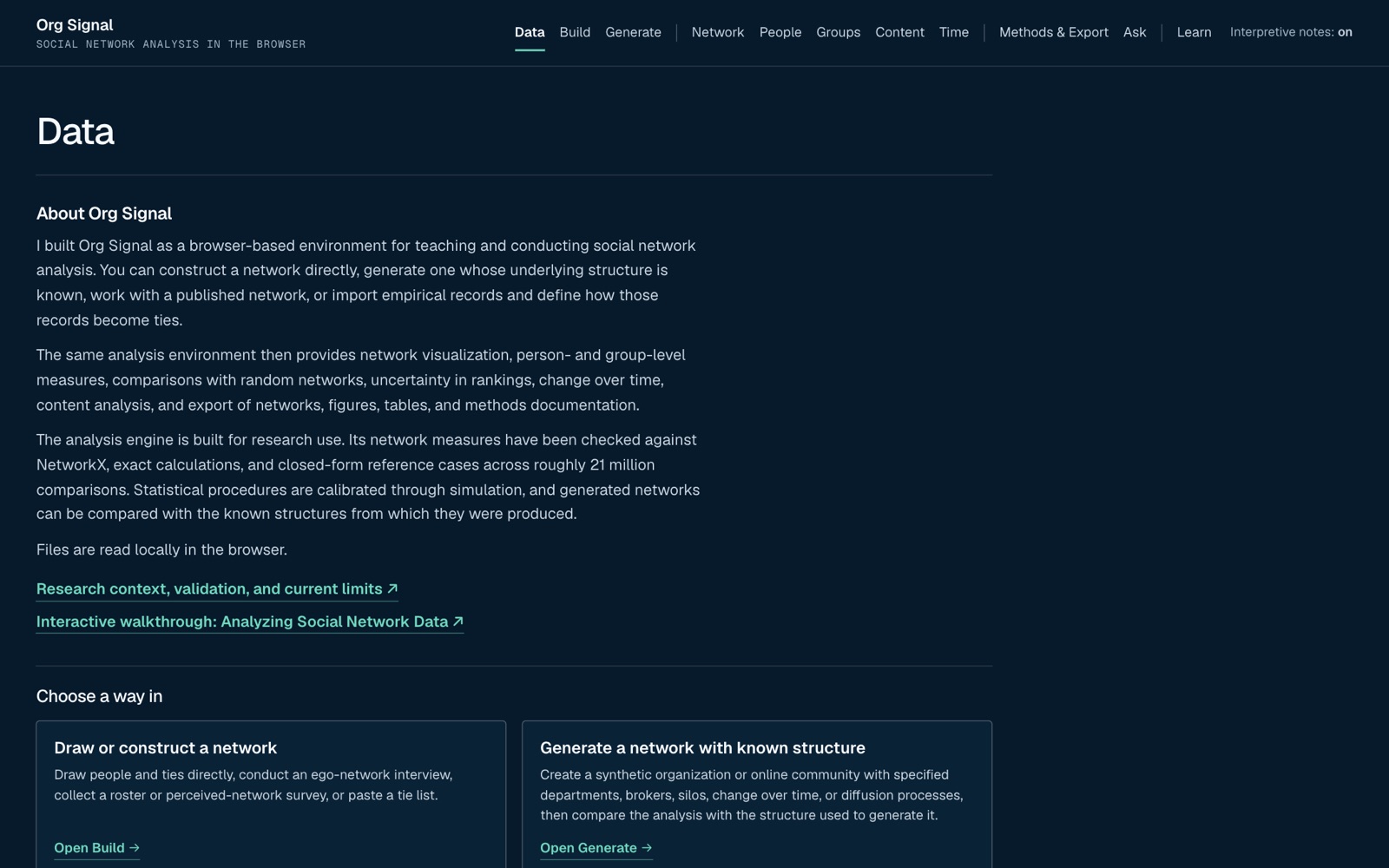
Org Signal start page
The current start page. Live at orgsignal.graystoneindustries.co.

Test design

AI-agent browser sessions with independent checks of reported network statistics

Eric

Testers and tasks

Ten testing roles: consultant, journalist, instructor, accessibility reviewer, design reviewer, three student profiles, a simulated class, and a learnability review

›

Automated (Claude)

Sessions in a real browser

Visible controls only, screenshots of every step, source read only afterward

›

Automated (Claude)

Independent checks

The numbers students reported were recomputed in networkx

›

Eric

Triage and decisions

Which findings were real, and which decision closes each class of problem

›

Eric, AI-assisted

Changes and re-test

Fixes built by area, then the same testers run again

Round 1, 2 Oct. Five testers: an organizational consultant, a journalist analyzing personal exports, a methods instructor, an accessibility tester, and a design reviewer checking fidelity to the site.

Round 2, 3 Oct. A Networks 101 course: an anxious novice, a rushed student, a strong student, an instructor with ten students, and a learnability review.

First-round findings

Round 1: 154 issue reports, many about how the network relates to the organization being analyzed

Consultant

A departed Slack account ranked second among brokers without a departure warning in the reported result.

Journalist

Four personal accounts were never joined, so "my network" came out as four islands.

Instructor

The recovery check never appeared, and planted and detected groups were both called "Community".

Accessibility and design

Strong basics, 7 major accessibility issues, and drift from the site's type and buttons.
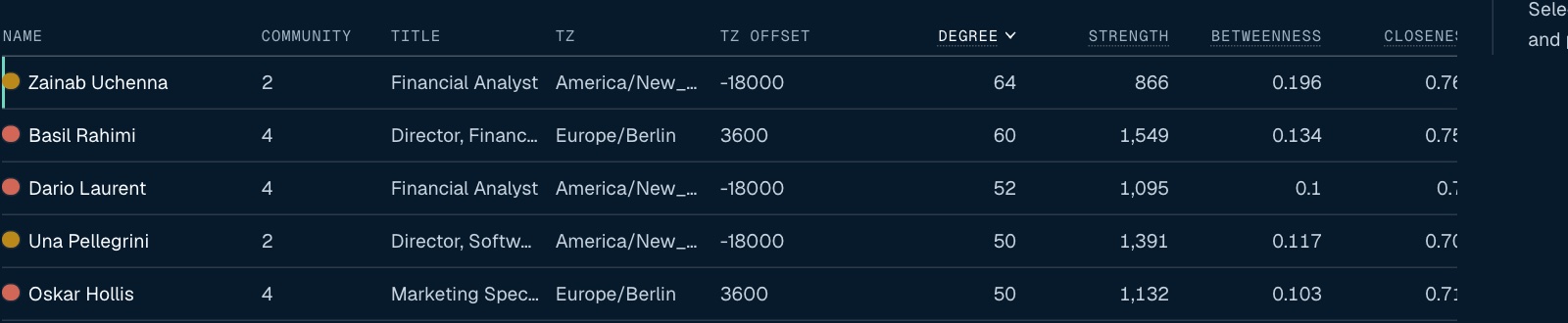
Before
Top of the People table before the UX work
The People table in the 2 Oct version, recaptured. The top-ranked person is a deactivated account, unmarked, and "Degree 64" counts each two-way tie twice.

From findings to changes

Seven cross-application decisions organized 135 issue assignments

154round-1 issue reports
›
135assigned to a fix
›
7binding decisions

Round 2 added nine more decisions, for sixteen in all.

Second round: agents with student profiles

Round 2: interpretation of network statistics under different tie definitions

Strong student

Recomputed every number in networkx. All matched. Including direct messages or not reordered the brokers completely.

Rushed student

Would have submitted something wrong or overstated on all three assignments.

Learnability review

The built-in "broker" example had a broker with zero betweenness, so it taught the wrong lesson.

Instructor and simulated class

AI-generated closeness ratings on a 1-to-5 scale were collected and then discarded.

99 issue reports and nine more decisions: a Learn view, plain-language readings, verdict-first statistics, and guards against overclaiming over time.

Departure-status indicators and distinct-contact counts

The same data in two application versions: departure status is visible, and the revised table reports distinct contacts
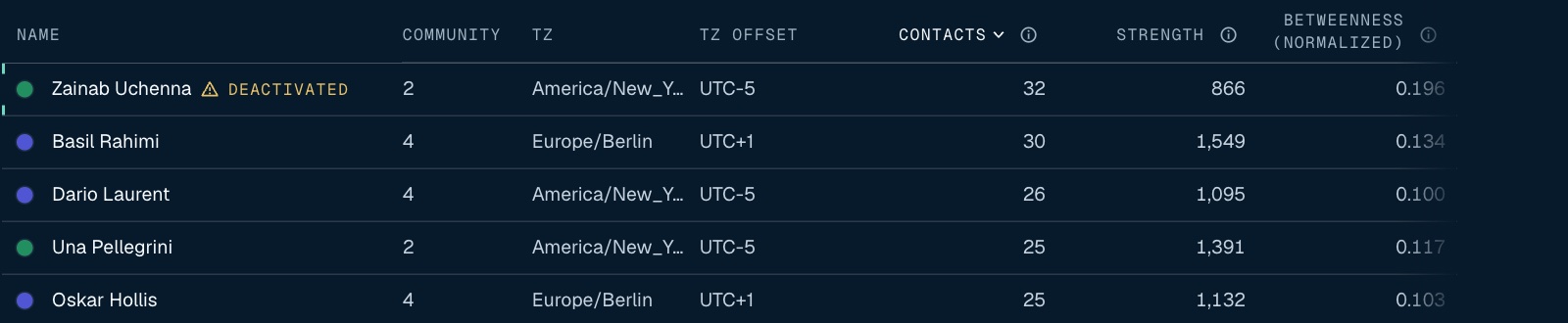
Before · 2 Oct
People table before
Zainab Uchenna leads with "Degree 64", and nothing says her account was deactivated.
After · 6 Oct
People table after
The same person, marked "Deactivated", with "Contacts 32": distinct people, not two-way ties counted twice. Both screens recaptured on 8 Oct from the two committed versions, with the same Slack export loaded the same way.

Known-answer evaluation of the revised interface

[test heading]

After · 6 Oct · the view that opens the analysis
Who stands out block, current version

[gap]

Design: five synthetic participant profiles, four tasks, and two application versions using fictional organizations with planted answers. Tasks, scoring rules, and predictions were specified before testing. Agents are not people: this shows which paths to a wrong conclusion the interface leaves open, not how much students learn.

Regression check for departure warnings

A deterministic check found three contexts where the departed employee appeared without a status warning

Where the departed broker is named2 Oct6 Oct
People table, her rownot markedmarked
Her profilenot markedmarked
"Who stands out" (three rankings)not shownnot marked
Brokerage summary sentencenot shownnot marked
Note beside the contacts measurenot shownnot marked

No AI. The fictional organization's data are imported through the application's own interface into two saved, read-only versions. The check examines selected references to the departed employee for an accompanying status marker.

Two omissions beyond the one the agent sessions exposed. The check returns the same answer every time, so it can run after every change. Agents answer a different question: whether a reader reaches the right conclusion.

6 Oct · "Who stands out" opens the network view
Who stands out block, current version

Regression corrections and prospective evaluation

Correct the remaining warnings, rerun the regression check, and evaluate interpretation with a revised known-answer study

Next study

  • First, add departure warnings to all three identified contexts and rerun the deterministic check
  • Then repeat the known-answer comparison in an environment where the agent tasks can be completed reliably
  • Test the revised interface with a Networks 101 class using planted-answer assignments
  • Primary measure: correctness of substantive conclusions under each interface version
  • Secondary measures: task time, help requests, and confidence in incorrect answers

Decision rule, set in advance

Keep a change when it reduces wrong conclusions without slowing correct ones. A change that only raises confidence is not an improvement.

[closing]